Wednesday, 8 December 2010

The Colours of Bloomberg

Dear Reader,


This week I will write about our class trip to the Bloomberg office in London. First of all I would like to thank our teacher, Linda Lewis for giving us the opportunity to visit Bloomberg and get a good idea of what the company not only does but what it looks like. The trip to Bloomberg was extremely interesting especially because it was a lot different from what I had expected and imagined.


When walking into the Bloomberg building in Finsbury Square the first thing one realizes is how secure and nice the building is. The first thing we received upon our arrival was our name tag and pass for the 2 hours that we were going  to spend in the building, we were then walked up to the very modern and environmentally friendly "cafeteria" were we had our first look around. Bloomberg seems to be an extremely ecological company, there are different bins for different trash and they seem to divide and recycle everything they find. This became even more obvious during our tour, when we were shown the furniture made out of recycled PC's and screens. I thought this was slightly unnecessary because first of all, it is quite uncomfortable to sit on steel and second of all it probably cost them more money to transform those screens into furniture then to buy some normal furniture.


We were taken around by a man and a woman, both seemed quite young and somewhat arrogant at times, the information they gave us seemed to be more superficial then necessary. The young man seemed to be more interested in talking about how many species of fish were in the acquarium then the actual company, it made it feel like we were visiting an aquarium rather then a global company. They then proceeded to taking us to a room and talking about the Bloomberg website and how it was used, one of the examples they used was "finsing good restaurants in London", which seemed sort of unprofessional and ridiculous. The last part of our tour was with a lady who worked for HR who explained to us the process of applying to Bloomberg and the internships offered at the company. She also explained that there is no hierarchy at Bloomberg and that everyone sits at the same desk and there is really no division. Every "new" person at Bloomberg also gets their picture put on a screen that will be shown in all Bloomberg offices. Now, this all seems very nice and "we are all equal" but a the same time I believe it was a little overdone. I do not believe that a company can have a "no hierarchy", there will alsways be a hierarchy in peoples heads, and we could not see what went on behind closed doors. 


While going through Bloomberg and receiving explanations from the guides, I felt as though it was all a bit fake. The aquarium were the female guide said she sat infront of to "relax" and the different colours on every floor which helped stimulate "creativity" or "relax" were simply a bit too much. I was also quite surprised to see that the people who worked at Bloomberg and were sitting at the desks were not dressed very well, some were wearing t-shirts and jeans and maybe being a bit naive about this, I expected people to be wearing suits. 


All in all I believe this was a great experience and eventhough it might seem like I only criticized the company, there was obviously very good sides to it too and since Bloomberg is doing very well I guess the way they work and approach the work evnvironment has been working for them. I am glad I could take part in this experience, and we also got to see a live presenter speaking for Bloomberg TV.


The Financialista 

The Present and Future of Commodities

Dear Reader,


As this will be my last financial blog I would like to write about something which I have been reading about since the start of my blog in September and which I believe will be an issue in the next months and years to come. The topic I will be writing about today is the commodity crisis, and the constant rise in commodity prices which leads to many more problems and issues.


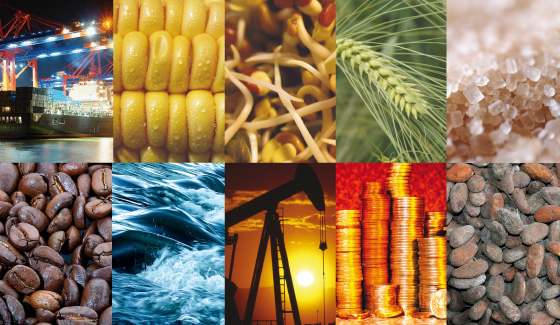
                    http://www.etftrends.com/wp-content/uploads/2010/10/commodities1.jpg


First of all, it is important to say that food prices have been going up since 2000 according to the World Bank (Sitkin, A. 2010) and the world population is constantly growing, there are nearly 7 billion people in the world now and that number is going to rise by another 3 billion by 2030 (Sitkin, A. 2010). More people need to eat, there is less land available and food prices are rising, there is bound to be a BIG problem. As Javier Blas states, the commodity crisis is coming at a very bad time, people are still thinking about the financial crisis and some of them have lost so much money that they are now struggling to put food on the table (Blas, J. 2009). There have been various food riots all over the world: Egypt, Haiti and Senegal for example in 2008 (Sitkin, A. 2010). Food is important for people, it is a necesity, and people who have enough of it do not realize how important it really is. Hilary Clinton, US Secretary of State recently said "Massive hunger poses a threat to the stability of governments, societies and borders" (Blas, J. 2009).


There are mainly four reasons of why commodity prices are rising so dramatically. First of all, there is less and less agricultural land available since people are urbanizing and land has been used to built on rather then to farm on. Secondly, the "world grain output has suffered from several years of poor harvest, often cause by droughts" (Sitkin, A. 2010). This is sometimes blames on global warming and the effects that it has been having on our world. Thirdly, crops have been used more to make biofuels such as ethanol and biodiesel: we are using the crops that we should be eating to make biofuels that we will then use to transport foods from an exotic place to the other. Its a viscious circle that does not make much sense. People have become spoiled and they want to have the best products from the furthest countries in the world, if we stuck to domestic products life would be much simpler and also there would be less problems to think about. Forthly, food is big business and this business is controled by few players, who are monopolizing the market. "90% of the world's grain supply is controlled by just five companies; three firms dominate the global tea market (Sitkin, A. 2010).


The commodity crisis will also put pressure on the Bank of England to rise interest rates and the recent fires in Russia will lead to "soring prices of wheat, barley, palm oil, cocoa, animal feeds and meat" (Thompson, J. 2010). The Western world has been trying to feed poorer countries in Africa and Asia, yet now there is a risk that even Western countries will be struggling to firstly find food for everyone and secondly to make it available for everyone to buy. Globalization has been extremely beneficial for the whole world yet it is now starting to show its bad sides also, globalization and the rise of China and India has lead to a rise in the middle class of these countries, which also means that more people can afford foods which they could previously not afford, especially proteins.


I started writing my blog talking about the rising price of gold and other precious metals and I have ended my blog talking about the rising commodity prices. It is not a coincidence that prices of almost everything have been rising and the question we have to ask ourselves is: where is this going? As we try to become more technological, advanced and globalized we see that it does not always work. In 2007 we saw the oil price rising to $140 a barrel and the fear that oil prices were going to rise even further due to its "scarcity", now we are facing commodity price hikes and precious materials and skyrocketing too. I believe that we should maybe take a step back and turn to domestic products yet again, we do not need to eat the banana from South America, we can eat the apple that has been grown in our backyard.


Have a good week,


The Financialista


Financial Times:
Blas, Javier (2009) "Global Hunger at top of political Agenda" Date Viewed: 5th December, 2010. Available online at:
http://www.ft.com/cms/s/0/683b88e4-cd5a-11de-8162-00144feabdc0.html?ftcamp=rss#axzz17WWJfnSs

The Independent:
Thompson, James (2010) "Commodity crisis sparks fear of food inflation on high street" Date Viewed: 4th December, 2010. Available online at:
http://www.independent.co.uk/news/business/news/commodity-crisis-sparks-fear-of-food-inflation-on-high-street-2048110.html

The World Bank (2010) "Commodity" Date Viewed: 4th December, 2010. Available online at:
http://search.worldbank.org/all?qterm=commodity

Straight Furrow
Vidal, John (2010) "When food runs out" Date Viewed:4th December, 2010. Available online at:
http://straightfurrow.farmonline.co.nz/news/world/world/general/when-the-food-runs-out/1983522.aspx

Books:
Sitkin, A. Bowen, N. (2010) "International Business: challenges and choices (2010). First Edition. Oxford Press


Images:

Future Industry (2010) Date Viewed: 4th December, 2010. Available online at:
http://www.futuresindustry.org/images/fimag/05-05commodity_notional.jpg

ETFTrends (2010) Date Viewed: 4th December, 2010. Available online at:

The Independent:
Thompson, James (2010) "Commodity crisis sparks fear of food inflation on high street" Date Viewed: 4th December, 2010. Available online at:
http://www.independent.co.uk/news/business/news/commodity-crisis-sparks-fear-of-food-inflation-on-high-street-2048110.html

Monday, 22 November 2010

Chaos in Ireland

Dear Reader,


This week I will be updating you on what has been happening in Ireland in the last couple of days. Ireland's momentary situation is extremely complicated since on one hand the country is in serious need of help yet on the other hand not everyone in Ireland wants to accept this help. Discussions about Ireland's future were held on monday between Brian Cowen, which is the current Irish Prime Minister, the European Union and the International Monetary Fund. The three parties agreed to negotiate a bail-out package for the country of €80 - €90 billion. 


http://www.dailymail.co.uk/news/article-1331979/IRELAND-BAILOUT-Cameron-Osborne-face-fury-Britains-7bn-loan.html


The bail-out package has been divided in three parts. Britain will give Ireland a £7 billion loan the rest of the package plan will be divided between the European Union (who will give two thirds) and the International Monetary Fund (who will give one third). This bail-out package has caused much controversy in the country since many people including Michael Lowry (one of two independents who currently prop up the country) and Jackie Healy Rae (independent for Kerry South) who said that he would "no longer support this government" (Brown, J. 2010). Eamon Gilore, who is the "leader of the opposition labour party association Dail, the Irish parliament" (Brown, J. 2010) went as far as saying that there should be an immediate general election. 


http://www.dailymail.co.uk/news/article-1331979/IRELAND-BAILOUT-Cameron-Osborne-face-fury-Britains-7bn-loan.html


Brian Cowen refuses to resign even though there have been protests all over the country and some protestors even broke in to his office on Monday. He said that he will call a general election in the New Year. Cowen's four year economic plan includes €10 billion public spending cuts and €5 billion tax raise.  The people in Ireland are obviously not very happy about this decision and the country is now not only highly indebted but also at war with itself. To add on to the dramatic situation, Moody's credit rating agency has also announced that it would downgrade Ireland saying that “a multi-notch downgrade, leaving the rating of the Republic (of Ireland) still within the investment-grade category, is now the most likely outcome of our review of the sovereign credit” (Brown, J. 2010). 


http://www.dailymail.co.uk/news/article-1331979/IRELAND-BAILOUT-Cameron-Osborne-face-fury-Britains-7bn-loan.html


The FTSE also fell by 0.5% today as well as the Euro with constant fears that Portugal and Spain will follow Greece's and now Ireland's footsteps. As I stated last week, the European Union might not be strong enough to carry such a load on their shoulders and bail-out every country that needs help. I believe that first of all Ireland needs to figure out its governmental problems and the problems that they have within the country because even the billion-euro bail-out plan will not help them resolve their internal issues. Second of all I think that the European Union should over-think what they have been doing for the last couple of years, the fact that they have been working more on "expansion" rather than making sure that the member countries were actually performing well. I feel as though the European Union is like a deck of cards and with one card taken away (Greece could be seen as this card), the whole deck is falling apart. 


Have a good week,


The Financialista 


Financial Times:
Brown, John Murray (2010) "Ireland plunged into political Turmoil" Date Viewed: 22nd November, 2010. Available online at: 
http://www.ft.com/cms/s/0/63dd1d9a-f634-11df-a313-00144feab49a.html?ftcamp=rss#axzz1629tk200

FT Reporters (2010) "Euro rally fades as contagion fears grip investors" Date Viewed: 22nd November, 2010. Available online at:
http://www.ft.com/cms/s/0/cedcc27c-f5f2-11df-99d6-00144feab49a.html#axzz162AW0tyo


Images:
Daily Mail (2010) "Irish PM refuses to stand down over financial crisis - but WILL call an election in the New Year" Date Viewed: 22nd November, 2010. Available online at:
http://www.dailymail.co.uk/news/article-1331979/IRELAND-BAILOUT-Cameron-Osborne-face-fury-Britains-7bn-loan.html


Wednesday, 17 November 2010

Bailing out Ireland

Dear Reader,


This week I will be writing about one of the most talked about topics of the week: the possible bail-out of the Irish Republic. The main articles I read this week were "Debt crisis team heads for Dublin" from the Financial Times and "EU begins Irish Republic bail-out talks" from the BBC News. As many of you may already know, Ireland is facing a recession at the moment, with unemployment rising and housing prices falling. Ireland has also been doing quite poorly with its governments bonds, which are usually regarded as safe long term investments, but in Ireland's case, with the market prices falling, the yields have been pushed up. The yield on a 10-year Irish bond reached around 9%, which is very high when compared to the UK's government 3% (Greece's yield is around 11%). Ireland now has to decide if they want to ask for help from the Eurozone and be bailed out as happened to Greece. When Greek bonds reached levels which made it impossible to make money from the bond market they turned to the International Monetary Fund and the European Union. 


http://www.reuters.com/resources/r/?m=02&d=20101116&t=2&i=250299040&w=460&fh=&fw=&ll=&pl=&r=2010-11-16T090914Z_01_BTRE6AD1SMB00_RTROPTP_0_IRELAND-POLL


The EU finance commissioner Olli Rehn said that they were already making bail out plans to help Ireland if the country decided to ask for help and that they were now much better prepared since a bail-out had already been done for Greece earlier this year and they know what to expect. The UK is ready to help Ireland for obvious reasons as British Chancellor George Osborne said "Ireland is our closest neighbour and it's in Britain's national interest that the Irish economy is successful and we have a stable banking system"(Niels, B. 2010). Some reports say that the UK is willing to give billions of pounds of direct loans to Ireland, this is because the UK's finance is linked with Ireland's finance since many  of the   UK banks have strong exposure in Ireland. BBC News also said that the Irish banking system needs to be "restructured" and that the Irish government will have to have a consultation with the Commission, the European Central Bank and the International Monetary Fund in order to see where the problems are and what needs to be fixed. 


http://www.guardian.co.uk/business/2010/nov/17/ireland-bailout-debt-crisis


The Financial Times revealed that a team of EU and International Monetary Fund will visit Ireland on Thursday to talk about this debt crisis, many professionals see this as a confirmation that Ireland will ask for the bail-out very soon. 


In my opinion there are two major problems with the crisis in Ireland. First of all, I believe Ireland is an extremely proud country and they will not be very happy if they have to accept help from the European Union. There have been many talks about Ireland in 2008 when they said no to the Lisbon treaty and then finally accepted it in 2009 (which seemed slightly forced because many people voted yes so that Ireland would not be blamed for the end of the Lisbon Treaty). The second problem I believe is that we cannot keep bailing out every country that has problems, yes, we should all be a big European community but I think that by bailing out first Greece, now possibly Ireland and who knows how many countries will follow, the European Union is simply hiding the mistakes the countries have made and is not really tackling the core problems. Will these countries ever be able to pay off these debts? I doubt it.


Have a good week,


The Financialista 


BBC:
Blythe, Niels (2010) "Q&A Irish Bond Crisis" Date Viewed: 16th November, 2010. Available online at:
http://www.bbc.co.uk/news/business-11743952


News Business (2010) "EU plays down Irish Republic bail-out talks" Date Viewed: 16th November, 2010. Available online at:
http://www.bbc.co.uk/news/business-11771574


Financial Times:
Spiegel, Peter (2010) "Debt crisis team heads for Dublin" Date Viewed: 16th November, 2010. Available online at:
http://www.ft.com/cms/s/0/54c2f752-f171-11df-8609-00144feab49a.html#axzz163JTRtg0

The Guardian:
Wearden, Graeme (2010) "Ireland's Debt crisis -today as it happened" Date Viewed: 16th November, 2010. Available online at:
http://www.guardian.co.uk/business/2010/nov/17/ireland-bailout-debt-crisis

Images:
Reuters (2010) Date Viewed: 16th November, 2010. Available online at:
http://www.reuters.com/resources/r/?m=02&d=20101116&t=2&i=250299040&w=460&fh=&fw=&ll=&pl=&r=2010-11-16T090914Z_01_BTRE6AD1SMB00_RTROPTP_0_IRELAND-POLL


Wearden, Graeme (2010) "Ireland's Debt crisis -today as it happened" Date Viewed: 16th November, 2010. Available online at:
http://www.guardian.co.uk/business/2010/nov/17/ireland-bailout-debt-crisis

Wednesday, 10 November 2010

Real Estate Decline

Dear Reader,


This week while reading the Financial Times I noticed an article that caught my attention. The article is entitled "Decline in house prices gathers pace". This article really interested me since I enjoy reading and keeping updated with real estate. It is quite interesting to see how the real estate market has been doing since the 2007 financial crisis. 


As we all know, many countries in the world including the United Kingdom, the United States and many countries in Asia and the Middle East saw falling real estate prices after 2007 which caused many people to lose a lot of money and many insecurities around the world. The real estate prices in the United Kingdom saw a rise over the past two years yet according to the article they are again starting to fall. many real estate professionals reported falling prices in the month of October. A survey conducted by the Royal Institute for Chartered Surveyors shows that 55% of the people surveyed believe that they have seen a downturn and falling prices while only 4% reported about rising prices.


http://www.foreclosuredeals.com/images/house-for-sale.jpg


Not only did the real estate prices fall in October, it was also the first time in eight months that fewer homeowners put their home on the market, people do not think that it is the right time to sell now. According to the article people are getting scared, and they do not feel safe about buying or selling a house anymore. On a more positive note though, the article also mentions that the prices will most probably not drop any further since fewer houses are being built and there is less supply. 


After the financial crisis people have become extremely skeptical about buying a home and the weakness of mortgage finance availability is making it much harder to buy homes, particularly for first time buyers. Renting has become much more popular and "safe" since the risks are much lower and people have to think of less issues and problems to deal with. 


I also found it quite interesting that at the end of the article, the author also mentions that according to the British Retail Consortium there has been a 2.4% rise in total sales this month, which is quite low when compared to the 5.9% rise seen in the same month last year. The total food sales on the other hand rose by 4% in the past 3 months compared with last year.


All this data shows that people have become a lot more conservative with the way they spend their money. The financial crisis affected almost everyone, and 3 years after the start of it, people are still suffering the consequences. In the United Kingdom much less money is going into clothing and luxury items while more money is being spent on food. People need an incentive to start buying again and keep the economy running. I believe that it will take quite a long time for people to gain that trust again since they have realized that it is better to save in case hard times come again, as Benjamin Franklin said "a penny saved is a dollar earned". 


Have a good week,


The Financialista 


Financial Times:
Pimlott, Daniel (2010) "Decline in house prices gathers pace" Date Viewed: 10th November, 2010. Available online at:
http://www.ft.com/cms/s/0/abba118c-eb70-11df-b482-00144feab49a.html

Images:
Foreclosure Deals (2010) Date Viewed: 10th November, 2010. Available online at:
http://www.foreclosuredeals.com/images/house-for-sale.jpg

Saturday, 16 October 2010

Is Economic Power Shifting from West to East?

Dear Reader,


This week I decided to do something slightly different since I am going to write about an interview I found on The Economist's website called "Stephen King talks about scarce resources". Since I am focusing part of my blog on resources I believed that this could be a very interesting interview to watch and report on. As some of you may already know, Stephen King is the group chief economist of HSBC, the Hong Kong and London bank. He has also written a book called "Loosing control: the threat to Western Prosperity", which talks about why emerging markets are posing a new threat to Western prosperity; this is also what he talks about in his interview with The Economist. 


http://www.waterstones.com/wat/images/nbd/m/978030/015/9780300154320.jpg


In the interview, Stephen King talks about the negative side effects of globalization such as the threat to western jobs, downward pressure on wages yet he focuses on the competition of scarce resources. Stephen King talks about how the Western society is so used to growing and always having more and how politicians keep promising that output is going to rise, income is going to rise and unemployment will be kept low, yet he believes this "Western" growth will soon end  due to the high growth of mainly eastern countries such as China, India and Russia. King explains that the west has already in the past experienced a scarcity of resources during the Industrial Revolution, but that it was easier for the powerful western countries at that time to hunt for resources elsewhere since most countries were extremely poor and could not find a way to use their resources. Now a days though western countries do not have this "monopoly on resources" anymore and the competition is hotting up again.


Oil, metal and food prices are not determined by the Western countries anymore and this is evident when we look at the riding oil prices in the past 2-3 years (oil prices kept rising throughout the financial crisis). People in the West are paying much more for their raw commodities yet their income is staying the same (this was not the case in the 1973 world food crisis when both raw commodity prices and wages rose). Today people are starting to fear the tremendous growth China has been experiencing, and Stephen King says that if things keep going the way they have been for the past 10 years, by 2030 only China will be consuming all of today's world production of oil. 


http://www.chrismadden.co.uk/news-cartoons/made-in-china.jpg


What Stephen King says is very interesting but it is nothing new, we all know that China is growing and we all know that emerging economies will play a much larger role in tomorrows economy. When looking at the interview I felt as though Stephen King was trying to scare the Western countries by telling them that they do not have total control over resources anymore, and he said it in a way that made it sound like he was appalled by this idea of "losing the monopoly". I personally believe that we only have ourselves to blame, we wanted globalization, we wanted to outsource our companies to the east to save money, we tried to take advantage of everything poorer countries had to give and now that they have learned to produce their own products and use their natural resources it is obvious that they will somehow try to use this newly acquired power against the western world. It is nothing strange and it is nothing that should surprise us and it was foolish of people to believe that the west would have the the power forever. 


             http://www.chrismadden.co.uk/news-cartoons/made-in-china.jpg


If the Western countries want to keep playing in the world market they will have to come up with new and improved ideas and find new ways to impress the world again. Nothing is going to change if we keep watching our plasma TV made in China, while eating our tropical fruit from Brazil and thinking of the next car we are going to by which is going to be fueled by Eastern oil. 


Have a good week,


The Financialista 


The Economist 
The Economist Multimedia (2010) "Stephen King on scarce resources" Date Viewed: 16th October, 2010. Available online at:
http://www.economist.com/blogs/multimedia/2010/10/stephen_king_scarce_resources

Images
Chris Madden (2010) Date Viewed: 16th October, 2010. Available online at:
http://www.chrismadden.co.uk/news-cartoons/made-in-china.jpg


Waterstones (2010) Date Viewed: 16th October, 2010. Available online at:
http://www.waterstones.com/wat/images/nbd/m/978030/015/9780300154320.jpg


Monday, 11 October 2010

World Food Crisis?

Dear Reader,


This week while reading the Financial Times I discovered an article which at first may not seem as important as other financial and world news, but when read through and analyzed it becomes clear that this news could negatively affect all of us. The title of the article I found is "Corn prices surge to two-year high" and the article itself obviously talks about the rising price of corn over the past week and the effects this might have on the world economy. 


http://uwstudentweb.uwyo.edu/L/LPETER11/corn2.jpg


First of all, it is very important to understand why this news is so important and what all the uses of corn are. One of the main uses of corn is in the food market where it is used in cereal, baby food, frozen foods, ketchup, margarine, mayonnaise, tacos/ tortillas, chewing gum, chocolate etc... but corn is also used to make bioproducts, corn-oil, ethanol, feed, sweeteners and starch. Its used to make batteries, insulation, paper manufacturing and even aspirin! Only on automobiles corn is used to make cylinder heads, spark plugs, synthetic rubber finishes and the tires. We are in contact with corn products all day everyday. Corn is the most important crop grown in the United States and one of the most important ones worldwide. 


The Financial Times article states that corn prices hit a two year high on Monday, jumping more than 8% "as traders scrambled to buy after the US Department of Agriculture warned last week of “dramatically” lower supplies because of bad weather". Corn prices have surged more than 15 per cent over the past two days. Normally the day limit for corn in Chicago is 30 cents but the barrier has been widened to 45 cents on Friday after corn prices rose drastically over the week. many analysts think that corn prices could go up to 6 dollars a bushel (each bushel of corn can produce up to 2.5 gallons of ethanol fuel), a level like this has only been seen during the peek of the 2007-08 food crisis which caused much trouble in the world. 


http://www.ft.com/cms/s/0/7ea9b2d0-d502-11df-ad3a-00144feabdc0.html?ftcamp=rss


One of the worst hit countries in the 2007-08 food crisis was Mexico where tortillas are extremely popular and (were) extremely cheap before 2007. The rise of the corn price obviously lead to an increase in the price of tortillas in some parts of mexico from $ 63 cents a kg to $ 1.36 - $ 1.81 dollars. With a minimum wage of $ 4.60 a day, many Mexican families were forced to either eat less tortillas (and be hungry) or switch to alternatives such as cheap noodles. This is just one of the many examples there are with the food crisis in 2007-08 along with increased prices of ethanol and meat.


Today the meat industry already warned of a "game changer" in prices and profitability due to the surprise contraction in the United States corn supply. Meat analysts forecast higher prices for beef, pork and poultry as producers pass on higher feeding cost, and shares of some of the world's largest meat producers fell sharply on Friday. Farm equipment such as tractors and fertilizers on the other hand soared  
Richard Feltes, analyst at brokers RJ O’Brien in Chicago, said: “Buy farm equipment stocks and sell food company stocks.”


http://www.washingtonpost.com/wp-dyn/content/article/2007/01/26/AR2007012601896_2.html


After reading this article I started thinking of how fragile the global food economy is and how one or two seasons of bad weather can cause such great damage to so many industries and to so many countries. Should we maybe start to think of more substitutes for corn since there aren't many around or should we be more cautious with how we use our resources? 


Have a good week,


The Financialista


Financial Times:
Mayer, Gregory (2010) "Corn prices surge to two-year high" Date Viewed: 11th October, 2010. Available online at:
http://www.ft.com/cms/s/0/7ea9b2d0-d502-11df-ad3a-00144feabdc0.html?ftcamp=rss

Corn Refiners Association:
Main Website (2010) Date Viewed: 11th October, 2010. Available online at:
http://www.corn.org/products.htm

The Washington Post:
The Washington Post (2007) Date Viewed: 11th October, 2010. Available online at:
http://www.washingtonpost.com/wp-dyn/content/article/2007/01/26/AR2007012601896_2.html

Images:


Mayer, Gregory (2010) "Corn prices surge to two-year high" Date Viewed: 11th October, 2010. Available online at:
http://www.ft.com/cms/s/0/7ea9b2d0-d502-11df-ad3a-00144feabdc0.html?ftcamp=rss


Student Web (2010) Date Viewed: 11th October, 2010. Available online at:
http://uwstudentweb.uwyo.edu/L/LPETER11/corn2.jpg


The Washington Post (2007) Date Viewed: 11th October, 2010. Available online at:
http://www.washingtonpost.com/wp-dyn/content/article/2007/01/26/AR2007012601896_2.html