
Dear Reader,
As this will be my last financial blog I would like to write about something which I have been reading about since the start of my blog in September and which I believe will be an issue in the next months and years to come. The topic I will be writing about today is the commodity crisis, and the constant rise in commodity prices which leads to many more problems and issues.
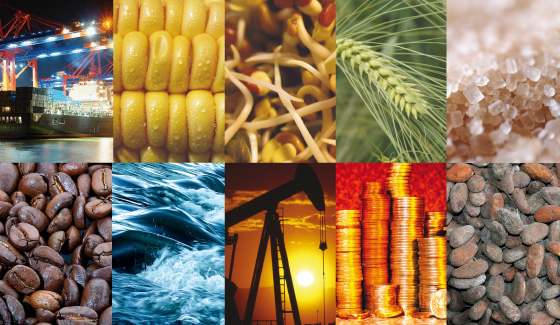
First of all, it is important to say that food prices have been going up since 2000 according to the World Bank (Sitkin, A. 2010) and the world population is constantly growing, there are nearly 7 billion people in the world now and that number is going to rise by another 3 billion by 2030 (Sitkin, A. 2010). More people need to eat, there is less land available and food prices are rising, there is bound to be a BIG problem. As Javier Blas states, the commodity crisis is coming at a very bad time, people are still thinking about the financial crisis and some of them have lost so much money that they are now struggling to put food on the table (Blas, J. 2009). There have been various food riots all over the world: Egypt, Haiti and Senegal for example in 2008 (Sitkin, A. 2010). Food is important for people, it is a necesity, and people who have enough of it do not realize how important it really is. Hilary Clinton, US Secretary of State recently said "Massive hunger poses a threat to the stability of governments, societies and borders" (Blas, J. 2009).

There are mainly four reasons of why commodity prices are rising so dramatically. First of all, there is less and less agricultural land available since people are urbanizing and land has been used to built on rather then to farm on. Secondly, the "world grain output has suffered from several years of poor harvest, often cause by droughts" (Sitkin, A. 2010). This is sometimes blames on global warming and the effects that it has been having on our world. Thirdly, crops have been used more to make biofuels such as ethanol and biodiesel: we are using the crops that we should be eating to make biofuels that we will then use to transport foods from an exotic place to the other. Its a viscious circle that does not make much sense. People have become spoiled and they want to have the best products from the furthest countries in the world, if we stuck to domestic products life would be much simpler and also there would be less problems to think about. Forthly, food is big business and this business is controled by few players, who are monopolizing the market. "90% of the world's grain supply is controlled by just five companies; three firms dominate the global tea market (Sitkin, A. 2010).
The commodity crisis will also put pressure on the Bank of England to rise interest rates and the recent fires in Russia will lead to "soring prices of wheat, barley, palm oil, cocoa, animal feeds and meat" (Thompson, J. 2010). The Western world has been trying to feed poorer countries in Africa and Asia, yet now there is a risk that even Western countries will be struggling to firstly find food for everyone and secondly to make it available for everyone to buy. Globalization has been extremely beneficial for the whole world yet it is now starting to show its bad sides also, globalization and the rise of China and India has lead to a rise in the middle class of these countries, which also means that more people can afford foods which they could previously not afford, especially proteins.

I started writing my blog talking about the rising price of gold and other precious metals and I have ended my blog talking about the rising commodity prices. It is not a coincidence that prices of almost everything have been rising and the question we have to ask ourselves is: where is this going? As we try to become more technological, advanced and globalized we see that it does not always work. In 2007 we saw the oil price rising to $140 a barrel and the fear that oil prices were going to rise even further due to its "scarcity", now we are facing commodity price hikes and precious materials and skyrocketing too. I believe that we should maybe take a step back and turn to domestic products yet again, we do not need to eat the banana from South America, we can eat the apple that has been grown in our backyard.
Have a good week,
The Financialista
Financial Times:
Blas, Javier (2009) "Global Hunger at top of political Agenda" Date Viewed: 5th December, 2010. Available online at:
http://www.ft.com/cms/s/0/683b88e4-cd5a-11de-8162-00144feabdc0.html?ftcamp=rss#axzz17WWJfnSs
The Independent:
Thompson, James (2010) "Commodity crisis sparks fear of food inflation on high street" Date Viewed: 4th December, 2010. Available online at:
http://www.independent.co.uk/news/business/news/commodity-crisis-sparks-fear-of-food-inflation-on-high-street-2048110.html
The World Bank (2010) "Commodity" Date Viewed: 4th December, 2010. Available online at:
http://search.worldbank.org/all?qterm=commodity
Straight Furrow
Vidal, John (2010) "When food runs out" Date Viewed:4th December, 2010. Available online at:
http://straightfurrow.farmonline.co.nz/news/world/world/general/when-the-food-runs-out/1983522.aspx
Books:
Sitkin, A. Bowen, N. (2010) "International Business: challenges and choices (2010). First Edition. Oxford Press
Images:
Future Industry (2010) Date Viewed: 4th December, 2010. Available online at:
http://www.futuresindustry.org/images/fimag/05-05commodity_notional.jpg
ETFTrends (2010) Date Viewed: 4th December, 2010. Available online at:
Thompson, James (2010) "Commodity crisis sparks fear of food inflation on high street" Date Viewed: 4th December, 2010. Available online at:
http://www.independent.co.uk/news/business/news/commodity-crisis-sparks-fear-of-food-inflation-on-high-street-2048110.html


No comments:
Post a Comment